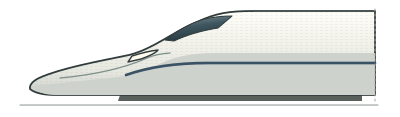
Look for the upright lamp on the cheek of the rounded nose. The plate shows the early design. Later 800s have more rounded lamp housings.
If the platform angle hides the nose, check the formation display: the 800 runs in six-car sets on this line, while the Kyūshū-serving N700 has eight. The 800 can work Sakura or Tsubame wholly within Kyūshū. The service name alone cannot identify the vehicle.
Look for a broad shoulder sweeping out from the base of the cab beside the flattened nose. The plate represents JR Kyushu’s eight-car R set.
This feature separates the N700 from the rounded 800 when both are plausible. JR West’s closely related eight-car S sets are the 7000 subseries. A distant nose view cannot distinguish S from R reliably. Look for the set marking or vehicle number; without it, record only “eight-car N700”.
When the view is incomplete
Look for a side view of the cab or the full formation. To distinguish two similar N700 sets, look for the set marking. Check the individual plates for the source of each clue.