A hill-climbing thermal problem
Repeated steep-gradient operation placed demands on more than motor output. Toshiba describes lighter equipment and stronger cooling throughout the main circuit, alongside smoother ATC-controlled station approaches.

Rolling stock
800 series
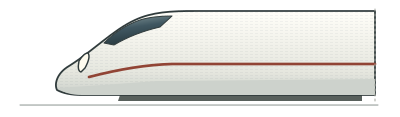
前照灯
Look for the upright lamp on the cheek of the rounded nose. The plate shows the early design. Later 800s have more rounded lamp housings.
Compare · N700 · San’yō · Kyūshū
鉄道車両カタログ · 800系| Identification clue | Upright headlamp |
|---|---|
| Formation | 6 cars |
Look for the upright lamp on the cheek of the rounded nose. The plate shows the early design. Later 800s have more rounded lamp housings.
If the platform angle hides the nose, check the formation display: the 800 runs in six-car sets on this line, while the Kyūshū-serving N700 has eight. The 800 can work Sakura or Tsubame wholly within Kyūshū. The service name alone cannot identify the vehicle.
Look for a rounded nose and upright lamps on either side. Early 800s have straighter lamp housings, later ones more rounded housings. If the lamps are hidden, check the formation display. Here an 800 has six cars and the Kyūshū-serving N700 has eight.
列車の設備 · 九州新幹線(8両・6両) · 九州新幹線800系の先頭部デザイン · JR九州800系800系 · 6両 · Documented specification 2004-03 / 2009-09
Power is distributed through all six cars to handle Kyūshū’s gradients. The converter rating uses MVA, an electrical apparent-power unit. It is separate from the motors’ mechanical output in kW.
| Powered formation | 6 powered cars (6M) |
|---|---|
| Design gradient context | 35‰ = 3.5% |
| Power converter rating | 1.25 MVA per converter 2 |
| Traction control | Transformer, converter and traction-motor system supplied by Toshiba |
| Traction converter cooling | Cooling capacity increased for steep-gradient operation 2 |
| Train protection | Single-stage ATC braking; later extension-build specification also supports the San’yō multi-stage function |
[1] 国内新幹線向け 車両システムと電気品 · 東芝 · 2009-09 · pp. 21–22, Table 3, §§3.1–4, Figure 6
[2] 九州旅客鉄道(株)800系新幹線電車向け主要電気品 · 東芝 · 2004-03 · p. 72, 交通システム
Original 800-series electrical equipment · March 2004
| Equipment ancestry | 700-series main-circuit equipment, adapted for Kyūshū |
|---|---|
| Thermal design scope | Converter, main transformer and traction motors |
| Station-approach control | Single-stage ATC braking from high speed into the station |
Repeated steep-gradient operation placed demands on more than motor output. Toshiba describes lighter equipment and stronger cooling throughout the main circuit, alongside smoother ATC-controlled station approaches.
The 2019 technical guide distinguishes inspection provisions within the later 800 fleet. U008 could carry track-inspection equipment, while U007 and U009 were equipped for electrical, signalling and communications measurement. The set number therefore tells you more than the shared exterior family.
800-0 · U001
Compare the tall lamp housings and the broad dark area surrounding the cab windows. These family features appear at both ends. Read the vehicle number to distinguish the 821 and 822 cab cars.
Head-on schematics. Scale is illustrative; lamps shown unlit.
JR九州800系U001編成 · formation · 800系編成表 · independent formation check · U001 · Train-Directory photograph
Travelling as a pair? A typical row on the six-car 800 has a pair of seats on each side of the aisle, in both ordinary reserved and non-reserved accommodation. Check the operator’s chart for individual rows and wheelchair spaces.
| Ordinary reserved | 2 + 2 | |
|---|---|---|
| Ordinary non-reserved | 2 + 2 |
Checked 2026-11-07
Two formation diagrams and exterior photos identify the eight-car N700 and six-car 800.
Rounded nose, upright headlights, differences on later builds and Kyushu-only operation.
Straight early lamp treatment and later rounded housings.
Vehicle/service table lists N700 for Mizuho, Sakura and Tsubame, and 800 for Sakura and Tsubame.