Powered noses need shielding
Powering both end cars adds a noise-control problem near ATC equipment. The design uses lower motor shields and protected wiring to limit direct interference.

车型
N700-8000
編成記号
若可能是800系或N700系,可用这道肩部轮廓与800系圆润的车头区分。JR西日本的7000番台采8节S编组,与R编组外观相近。仅从远处看车头难以判断,应找编组标记或车辆编号;若看不清,只宜记为「N700系8节编组」。
鉄道ホビダス · S編成/R編成| 识别特征 | 向两侧突出的肩部 |
|---|---|
| 编组 | 8 辆编组 |
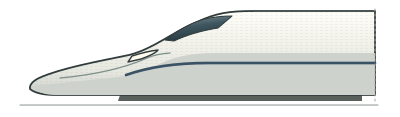
扁平的鼻端两侧,可见从驾驶室下方向外展开、像肩膀一样的轮廓。图中是JR九州的N700系8000番台,采8节R编组。
若可能是800系或N700系,可用这道肩部轮廓与800系圆润的车头区分。JR西日本的7000番台采8节S编组,与R编组外观相近。仅从远处看车头难以判断,应找编组标记或车辆编号;若看不清,只宜记为「N700系8节编组」。
扁平的鼻端和向外展开的肩部,能帮助区分N700系与800系。JR九州的R编组与JR西日本的S编组从这个角度看很相似,请找编组标记或车辆编号。只能确认车型和节数时,可记为「N700系8节编组」。
列車の設備 · 九州新幹線(8両・6両) · JR東海/西日本/九州 N700系 · N700系7000番代/8000番代N700-7000 S / N700-8000 R · 8両 · Documented specification 2009-09
These figures cover the eight-car S and R designs. The combined motor rating is 9,760 kW. Actual speed depends on the line, restrictions and the individual journey.
| Powered formation | 8 powered cars (8M) |
|---|---|
| Traction unit | 4 cars per traction unit |
| Traction motor | Three-phase induction motors |
| Output per traction motor | 305 kW per motor |
| Combined motor output | 305 kW × 32 motors = 9,760 kW |
| 牵引控制 | VVVF inverter drive |
| Operating speed by line | San’yō 300 km/h · Kyūshū 260 km/h |
| Starting acceleration | 2.6 km/h per second |
| Transformer primary capacity | 5,600 kVA per main transformer |
| Traction converter cooling | Forced-air boiling cooling |
| Design gradient context | 35‰ = 3.5%; all-powered formation developed for Kyūshū gradients |
[1] 国内新幹線向け 車両システムと電気品 · 東芝 · 2009-09 · pp. 21–22, Table 3, §§3.1–4, Figure 6
Eight-car N700-7000/8000 S/R design · 2009
| Degraded-mode restart | Designed to restart on a 35‰ uphill gradient |
|---|---|
| Ride control | Semi-active control in every car |
| Converter maintenance | Converter and inverter units withdraw from the vehicle side |
Powering both end cars adds a noise-control problem near ATC equipment. The design uses lower motor shields and protected wiring to limit direct interference.
N700-8000 · R1
Look for the compact lamps on the broad nose shoulders and the smaller, separated cab glazing. The drawing represents the R-series cab design; the photograph reference shows R2. The car numbers below identify R1’s two ends.
Head-on schematics. Scale is illustrative; lamps shown unlit.
JR九州N700系R1編成 · formation · JR九州N700系編成表 · independent formation check · N700系8000番台R2編成が山陽新幹線へ初入線 · railf.jp · 2010-12-06
On the eight-car San’yō–Kyūshū N700, a typical ordinary reserved row has four seats. The non-reserved cabin in cars 1–3 has five across, so only the three-seat side has a middle seat. On Kodama, non-reserved cars 7 and 8 have two seats on either side of the aisle. Confirm the reservation designation for your departure.
| 普通车指定席 | 2 + 2 | |
|---|---|---|
| 普通车自由席 | 2 + 3 | |
| 绿色车厢 | 2 + 2 |
核查日期 2026-11-07
两张编组图及列车外观照片,分别标明N700系为8节、800系为6节。
7000番台/S编组和8000番台/R编组的名称、所属公司及各型外观照片。
首段说明JR西日本与JR九州两种实车的所属及番台差异。
新大阪至鹿儿岛中央的运行区间,以及瑞穗号、樱花号的8节编组。
车型对照表列出瑞穗号、樱花号、燕子号可使用N700系,樱花号与燕子号也可使用800系。