Powered noses need shielding
Powering both end cars adds a noise-control problem near ATC equipment. The design uses lower motor shields and protected wiring to limit direct interference.

차량
N700계 8000번대 · N700-8000
編成記号
이 형태는 선두부가 둥근 800계와 N700계를 구분하는 단서입니다. JR 서일본의 7000번대 S편성도 이와 비슷한 8량 열차입니다. 멀리서 보이는 코 모양만으로는 S와 R을 구별하기 어렵습니다. 편성 기호나 차량 번호가 보이지 않는다면 ‘N700계 8량’까지만 기록하세요.
鉄道ホビダス · S編成/R編成| 식별 특징 | 날개처럼 돌출된 어깨 |
|---|---|
| 편성 | 8량 편성 |
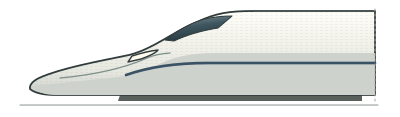
납작한 코 양옆으로 운전실 아래에서 시작되는 넓은 돌출부가 이어집니다. 그림은 JR 규슈의 8량 R편성을 나타냅니다.
이 형태는 선두부가 둥근 800계와 N700계를 구분하는 단서입니다. JR 서일본의 7000번대 S편성도 이와 비슷한 8량 열차입니다. 멀리서 보이는 코 모양만으로는 S와 R을 구별하기 어렵습니다. 편성 기호나 차량 번호가 보이지 않는다면 ‘N700계 8량’까지만 기록하세요.
납작한 코와 양옆의 넓은 돌출부로 N700계와 800계를 구별할 수 있습니다. 하지만 JR 규슈 R편성과 JR 서일본 S편성은 이 각도에서 비슷해 보입니다. 편성 기호나 차량 번호를 보세요. 편성 길이까지만 확인했다면 ‘N700계 8량’으로 기록하세요.
列車の設備 · 九州新幹線(8両・6両) · JR東海/西日本/九州 N700系 · N700系7000番代/8000番代N700-7000 S / N700-8000 R · 8両 · Documented specification 2009-09
These figures cover the eight-car S and R designs. The combined motor rating is 9,760 kW. Actual speed depends on the line, restrictions and the individual journey.
| Powered formation | 8 powered cars (8M) |
|---|---|
| Traction unit | 4 cars per traction unit |
| Traction motor | Three-phase induction motors |
| Output per traction motor | 305 kW per motor |
| Combined motor output | 305 kW × 32 motors = 9,760 kW |
| 구동 제어 | VVVF inverter drive |
| Operating speed by line | San’yō 300 km/h · Kyūshū 260 km/h |
| Starting acceleration | 2.6 km/h per second |
| Transformer primary capacity | 5,600 kVA per main transformer |
| Traction converter cooling | Forced-air boiling cooling |
| Design gradient context | 35‰ = 3.5%; all-powered formation developed for Kyūshū gradients |
[1] 国内新幹線向け 車両システムと電気品 · 東芝 · 2009-09 · pp. 21–22, Table 3, §§3.1–4, Figure 6
Eight-car N700-7000/8000 S/R design · 2009
| Degraded-mode restart | Designed to restart on a 35‰ uphill gradient |
|---|---|
| Ride control | Semi-active control in every car |
| Converter maintenance | Converter and inverter units withdraw from the vehicle side |
Powering both end cars adds a noise-control problem near ATC equipment. The design uses lower motor shields and protected wiring to limit direct interference.
N700-8000 · R1
Look for the compact lamps on the broad nose shoulders and the smaller, separated cab glazing. The drawing represents the R-series cab design; the photograph reference shows R2. The car numbers below identify R1’s two ends.
Head-on schematics. Scale is illustrative; lamps shown unlit.
JR九州N700系R1編成 · formation · JR九州N700系編成表 · independent formation check · N700系8000番台R2編成が山陽新幹線へ初入線 · railf.jp · 2010-12-06
On the eight-car San’yō–Kyūshū N700, a typical ordinary reserved row has four seats. The non-reserved cabin in cars 1–3 has five across, so only the three-seat side has a middle seat. On Kodama, non-reserved cars 7 and 8 have two seats on either side of the aisle. Confirm the reservation designation for your departure.
| 보통차 지정석 | 2 + 2 | |
|---|---|---|
| 보통차 자유석 | 2 + 3 | |
| 그린차 | 2 + 2 |
확인일 2026-11-07
두 편성도와 외관 사진에서 N700계 8량과 800계 6량을 확인할 수 있습니다.
7000번대/S편성과 8000번대/R편성의 대응 관계, 운영사 및 형식별 외관 사진.
첫 문단에 서로 비슷한 JR 서일본과 JR 규슈 실차의 형식이 나옵니다.
신오사카~가고시마추오 운행 구간과 미즈호·사쿠라의 8량 편성.
차량별 열차명 표에서 N700계는 미즈호·사쿠라·쓰바메, 800계는 사쿠라·쓰바메에 해당합니다.